
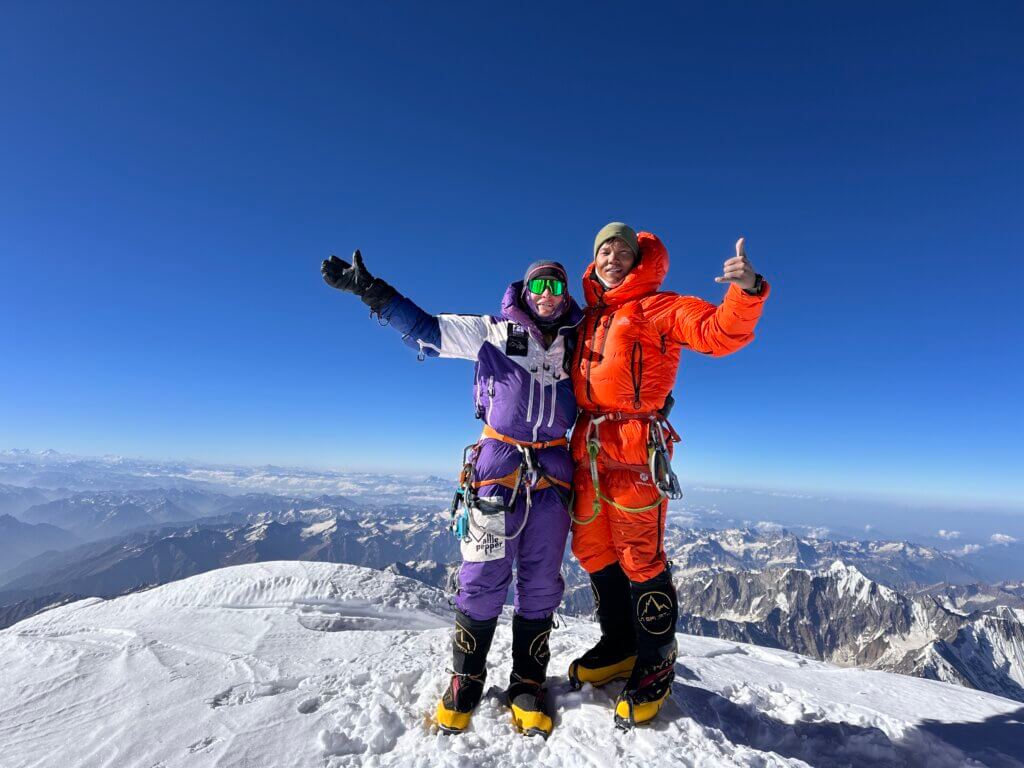
On the 4th of July, I stood on the summit of Nanga Parbat at 8,126 metres, becoming the first Australian woman to reach the top of this legendary mountain. It was one of the hardest and most intense climbs of my life.
Nanga Parbat is known as one of the world’s most dangerous 8,000m peaks, and this season it lived up to every part of that reputation. The mountain was dry, unstable and relentless. There had been very little snowfall, leaving steep hard ice, loose rock and constant rockfall through the lower face. Every move demanded focus. Every day required courage.
The climb to Camp 2 on our first rotation was marked by a terrifying near miss when a huge boulder broke free high above us and exploded just metres away. Rock fragments flew everywhere. One struck my arm, but somehow my climbing partner Mikel and I escaped serious injury. Shaken but grateful, we continued upward.
After reaching 6,300m on rotation and spending two nights at Camp 2, we returned to Base Camp to recover and wait for a summit window. I was battling gastro again, but with treatment and determination I regained enough strength to go back up when the forecast finally opened.
We climbed from Camp 1 to Camp 2 overnight to avoid the sun-triggered rockfall, then continued to Camp 3 through brutal conditions of hard ice and falling stone. From there, we established Camp 4 at 7,260m to give me the best chance of a no-oxygen summit push. But the mountain had more to give emotionally. During the night, our friend Klara descended alone after turning back from her summit attempt. We later received news over the radio that she had fallen and did not survive. It was heartbreaking and deeply confronting. With heavy hearts, we continued.
We left Camp 4 around 10:30pm for the summit. After several hours climbing in the dark, my legs began to fail from the accumulated fatigue of the season and the brutal ice climbing lower on the route. At 7,500m I made the difficult decision to use emergency oxygen. It was not the outcome I had hoped for, but it was the right decision to stay safe and continue upward.
At sunrise, we reached the end of the fixed ropes. Ahead was loose rock, exposed scrambling and a final snow slope leading to the summit. Then suddenly, everything changed. No wind. No fear. Blue sky in every direction. A perfect summit. We stood on top of Nanga Parbat with the Karakoram spread endlessly around us. It was one of the most beautiful moments I have ever experienced in the mountains.
We spent nearly an hour on top filming, reflecting and taking it all in before beginning the long descent. The way down was harrowing. The lower face had deteriorated even further. Anchors had ripped out, ropes were jammed, and rockfall returned as soon as the sun hit the wall. We were emotionally shattered by the time we reached Camp 1, and overwhelmed with relief when we finally walked back into Base Camp alive.
This mountain humbled me. It stripped away ego and reminded me that success in the high mountains is never guaranteed. Sometimes courage is pushing on. Sometimes courage is adapting the plan. Sometimes courage is simply surviving.
I am proud to have become the first Australian woman to summit Nanga Parbat, but even more grateful to have come home safely. The 14 Peaks journey continues.